Remote Work And Commute Options From Placeholder Neighborhood
June 11, 2026
June 11, 2026
If you work from home full time or split your week between home and the office, where you live still shapes your day more than you might expect. You may not need a perfect commute every morning, but you probably do want a home that supports focus and a location that keeps key destinations within reach. This guide walks you through how to think about remote work and commute options in Placeholder Neighborhood using practical Triangle-wide benchmarks while you refine your home search. Let’s dive in.
Even in a remote or hybrid setup, job access remains a major factor for many buyers. In the National Association of Realtors 2024 generational trends data, 38% of buyers said convenience to a job influenced their neighborhood choice, and 13% said distance from work was one of the compromises they made.
That tells you something important. Even if you only go in once or twice a week, the trip still affects how convenient your home feels over time. It can influence your schedule, your stress level, and how flexible you feel when plans change.
A 2023 NAR buyer study adds more context. It found that 16% of buyers worked fully remote, while the median planned commute was 30 driving minutes and 43% of buyers were aiming for 20 minutes or less.
In the Triangle, commute planning works a little differently than in a market built around one downtown. This region has several major job nodes, so most buyers are better served by choosing one or two anchor destinations that matter most to their household.
That could mean downtown Raleigh and Research Triangle Park. For another household, it might mean downtown Durham and RDU. If you are considering Placeholder Neighborhood, that is the right mindset to bring into your search.
GoTriangle’s regional coverage reflects that multi-node layout. Its service area includes Apex, Cary, Chapel Hill, Durham, Garner, Hillsborough, Knightdale, RDU, Raleigh, Research Triangle Park, Wake Forest, Wendell, and Zebulon.
Because the neighborhood name here is still a placeholder, the best starting point is regional travel benchmarks rather than exact drive times. These are not live traffic estimates, but they help you get a feel for how the Triangle connects.
Here are a few useful reference points from the region:
These benchmarks matter because they show how spread out the Triangle can be. A neighborhood may feel convenient for one work pattern and less convenient for another, so your own routine should lead the decision.
When you look at homes in Placeholder Neighborhood, start with your real weekly pattern. Ask yourself where you actually go most often, not where you might go once in a while.
A simple way to evaluate the location is to focus on these questions:
That approach usually gives you a clearer answer than chasing a home that tries to be equally close to everything. In the Triangle, flexibility often matters more than perfection.
If you want an alternative to driving, regional transit may still play a helpful role in your routine. GoTriangle operates regional bus and shuttle service, paratransit, ridematching and vanpools, plus an emergency ride home program.
That matters if your work schedule changes from week to week. You may not ride transit every day, but having a backup option can make a location more practical.
Some of the most relevant regional routes connect the places many buyers care about most:
If your commute points toward Durham, GoDurham may also be part of the picture. It operates 19 bus routes seven days a week, generally from 5:30 a.m. to 12:30 a.m. Monday through Saturday and 6:30 a.m. to 9:30 p.m. on Sundays and holidays.
For some buyers, a nearby park-and-ride lot can make a neighborhood more workable. GoTriangle notes that most park-and-ride lots are free, though some may require registration, and overnight parking is not allowed.
Examples across the region include Cary Depot, Durham Station, RTC, District Drive, South Square, Woodcroft Shopping Center, and Renaissance Village. If Placeholder Neighborhood ends up near one of these corridors, that may give you another way to manage a hybrid work schedule.
This can be especially useful if your household shares one vehicle during the week or wants to reduce the wear and tear of a longer drive. It is not the top priority for every buyer, but it can be a meaningful plus.
Working from home is no longer a niche housing need. The U.S. Census Bureau reported that the share of workers working from home increased from 5.7% in 2019 to 17.9% in 2021.
That shift helps explain why home search priorities have changed. Buyers still care about neighborhood fit and access to work, but they are also paying closer attention to how a home functions during the day.
NAR data also suggests that buyers want flexibility first. In the 2024 generational trends report, neighborhood quality, convenience to friends or family, affordability, and convenience to a job ranked high, while convenience to public transportation ranked much lower overall.
For you, that means the strongest match is often a home that supports daily life well and still keeps your commute manageable. You do not always need the shortest drive. You need a setup that works in real life.
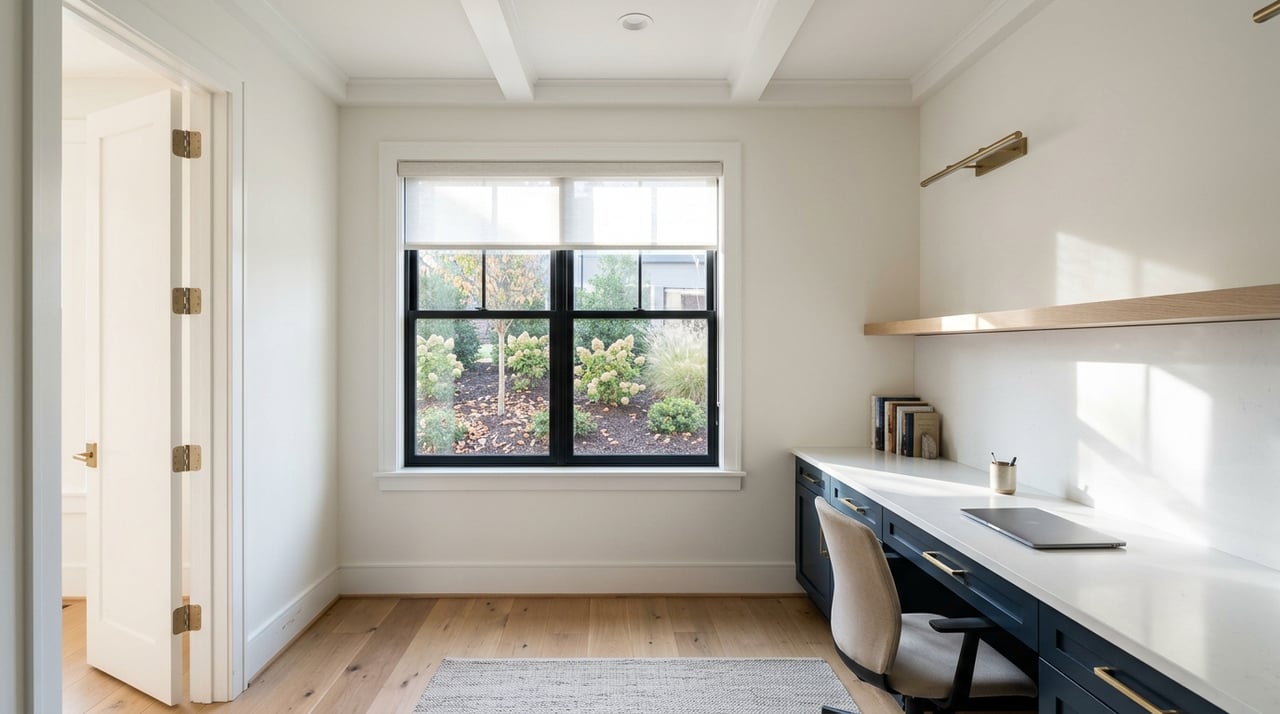
If you are shopping in Placeholder Neighborhood, look beyond the label of “home office.” What matters most is whether the layout supports privacy, calls, storage, and comfort.
Based on buyer preference data highlighted by NAR, many households still value practical features such as laundry rooms, patios, energy-efficient windows and appliances, garage storage, programmable thermostats, security cameras, wired security, multi-zone HVAC, lighting control systems, and video doorbells.
For remote and hybrid work, the most useful features often include:
Interestingly, NAR’s reporting also found that among buyers willing to reduce home size, 53% would cut the home office before the kitchen or closets. That is a good reminder that you may not need a dedicated office if the floor plan offers smart, flexible space elsewhere.
Reliable internet is a big part of any remote-work plan, but it is something you should verify at the property level. The FCC says broadband availability data are location-specific and based on where mass-market fixed broadband can be installed.
That means you should not assume every home in Placeholder Neighborhood has the same service options just because the area is marketed as work-from-home friendly. Two homes on nearby streets can have different availability.
Before you make an offer, confirm internet service for the specific address you are considering. That step is simple, but it can save you from a frustrating surprise after closing.
If you are deciding whether Placeholder Neighborhood fits your routine, keep your evaluation simple and honest. Start with the places you need to reach most often, then test whether the home itself supports your work style.
Here is a useful checklist:
This method helps you focus on what will matter after move-in, not just what sounds good in a listing. It also makes it easier to compare homes across the Triangle on the same terms.
In a region like the Triangle, location decisions are rarely just about mileage. They are about patterns, tradeoffs, and how your household actually lives from Monday through Friday.
That is why neighborhood-level guidance matters. A home can look ideal online, but your real decision often comes down to commute rhythm, access to major corridors, and whether the layout truly supports remote work.
If you are exploring Placeholder Neighborhood real estate and want help weighing commute options against floor plan, lifestyle, and long-term fit, Eric Rainey can help you sort through the details with a clear, practical approach.
DDR Realty are dedicated to helping you find your dream home and assisting with any selling needs you may have. Contact us today to start your home searching journey!